The Commute Between Stops: A Small Practice of Noticing
A commute between stops can become a gentle attention practice: notice ordinary details along your familiar route without adding time or changing it.
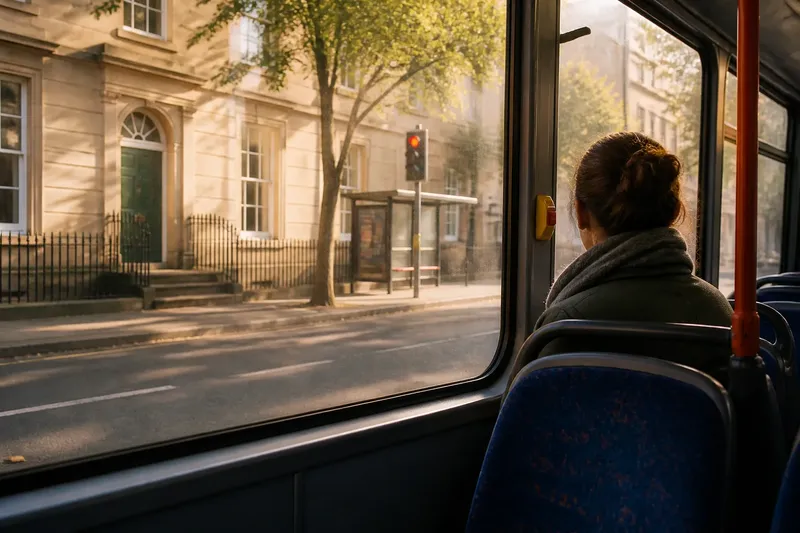
The most common mistake on a familiar commute is treating every stretch between stops as empty time that needs filling. A commute between stops can instead offer a small practice of noticing: name a few neutral details as you travel, without changing your route or adding another task. The point is not to make the journey special, but to notice the journey already underway.
This works best as a light touch, not a concentration exercise. You are not trying to empty your mind, feel calm, or remember every detail. You are giving attention a small, present-tense job while the bus rolls, the train pauses, or your walk follows its usual blocks.
What counts as noticing on a familiar commute?
Noticing means registering something observable without judging it or turning it into a story. A pale rectangle of sunlight on a brick wall, the soft rattle of a window, a blue seat cover, or the pause between a door chime and the doors opening are all usable details.
Neutral does not mean dull. It means leaving out the verdict. “The platform smells of rain” is an observation; “this station is miserable” adds an evaluation. A plain description can keep attention near what is happening now rather than sending it into complaints, memories, or predictions.
Choose details that are easy to notice from where you are. You do not need to look around sharply, lean out, or inspect other passengers. If the route is crowded, noisy, or visually busy, a detail from sound, light, temperature, or the movement beneath your feet may be enough.
When should you begin noticing on your commute?
Pick a transition already built into the journey: leaving your front door, reaching the corner, boarding, hearing the doors close, or crossing a familiar bridge. Use that ordinary cue as a reminder. You are attaching attention to a moment that would happen anyway, not setting aside more time.
Keep the cue flexible. If you are carrying groceries, helping someone, or watching for a safe crossing, let the practice wait. It should fit around the real demands of the trip, not compete with them.
On a walk, you might begin after stepping onto the sidewalk. On public transit, begin once you are settled and no longer need to find a seat or check a connection. If you drive, keep your eyes and attention on the road; do not close your eyes, look away to search for details, or let the practice distract you. You can name a detail already in your field of view when safe, or leave the practice for another part of the journey.
How do you name a detail without making it a task?
Use a short, literal phrase, silently or aloud if you are alone and prefer that: “Gray sky above the roofs,” “warm cup in my left hand,” or “the train is slowing.” A few words are enough; there is no need to compose a polished sentence or keep a running account.
Then let the detail go. Notice another when one naturally appears, or return to the sound of the wheels, the feel of your coat, or the view through the window. If your mind moves to an appointment or an unfinished message, recognize that it has wandered and gently name what is present again. You do not need to scold yourself or restart.
Say you take the same bus to work and usually replay a conversation as you pass the library. One morning, you notice its green door, the bus’s brief pause at the light, and a paper notice shifting behind the window. The expected result is modest: for a moment, your attention registers the ride itself instead of following only the replay. The conversation may return; noticing does not require it to disappear.
How many details are enough on a commute?
There is no quota. A single detail can be enough for one stretch; another day, you may notice several without effort. If counting begins to feel like a score, drop the count. The practice is not a challenge to complete before your stop.
One useful rhythm is to notice a detail, allow a little silence, and notice again only when something catches your attention. This leaves room for the rest of the commute. You can listen to a necessary announcement, respond to a passenger, or think through something that genuinely needs thought.
Some days, the useful choice is to stop noticing on purpose. If you feel overloaded, tired, or unsettled, you might prefer music, quiet, a conversation, or simply getting where you are going. Attention is not improved by forcing a practice onto every journey.
What should you do when your commute route changes?
A delay, detour, or crowded carriage can make a familiar trip less predictable. Rather than searching for expected details, name what is actually present: the announcement’s steady tone, a different view from the window, or the feeling of your bag against your leg. If the change needs your attention, such as finding another platform, attend to that first.
On a routine route, repeated landmarks can help you notice small differences without turning them into a test. The same bakery may have its lights on or off; a tree may cast a different shadow; the platform may sound louder than before. You can register the change without deciding what it means.
Do not make the practice depend on a particular kind of journey. A quiet ride is not more successful than a noisy one. Meet the details that are available rather than arranging the trip around ideal conditions.
What questions come up about noticing during a commute?
Does this practice require silence?
No. You can notice a sound, a texture, or a view while the journey carries on around you. If noise feels tiring, choose a softer detail or pause instead of adding more attention to it.
Can I use it while walking?
Yes, if you keep your attention available for sidewalks, crossings, other people, and changing conditions. Notice what is already within your ordinary view rather than turning your walk into a search.
What if I keep thinking about work?
That is ordinary. Briefly name a present detail, then let your thoughts return if they need to; the practice is a gentle redirection, not a demand to stop thinking.
Is there a right number of details to notice?
No set number is needed. One observation may be plenty, and you can leave the practice alone whenever it stops feeling useful.
How can you keep commute noticing from becoming an obligation?
Make the invitation small enough to decline. You might think, “I’ll notice one thing after the next stop,” rather than promising yourself a full journey of focused attention. If you forget, there is nothing to catch up on.
Keep descriptions plain and private. You do not need to record them, share them, or turn them into a reflection later. Writing can be useful for other purposes, but here it may pull attention away from the uncomplicated act of seeing or hearing.
It can also help to leave the practice unfinished. You do not need to carry a final observation through the door or decide whether the commute went well. When the next demand arrives, let attention meet it. A small practice has done enough when it briefly reconnects you with the place you are already in.
The commute between stops does not need to become a retreat from the day. It can remain a commute, with its timetable, weather, noise, and familiar corners. If you remember to name one neutral detail, that is enough to give the ordinary journey a little more of your attention.